


I. Cut the Noise, Build the House
Lately, it feels like everyone has a new idea of what Governance, Risk and Compliance “GRC” should stand for. Rearranged acronyms. Added letters. Branding workshops with more heat than light.
I’ve never been particularly attached to the term myself. Not because I think it’s wrong—but because I think it’s small. Governance isn’t just one slice of a risk-compliance sandwich. It’s the roof over the entire structure. And if we’re serious about building organizations that actually hold up, we’ve got to stop fussing with the label on the blueprint and start paying attention to the structure itself.
That’s where this house comes in. (See below.)
Governance, real governance, isn’t an abstraction. It has shape. It has weight. It rests on ethics/culture/risk/performance, and compliance/reporting—yes—but it also depends entirely on what lies beneath: information and communication. And today, with automation and AI at our fingertips, we finally have a chance to rebuild that structure the right way.
II. Governance Is the Roof, Not Just a Letter
Figure 1: The Governance House
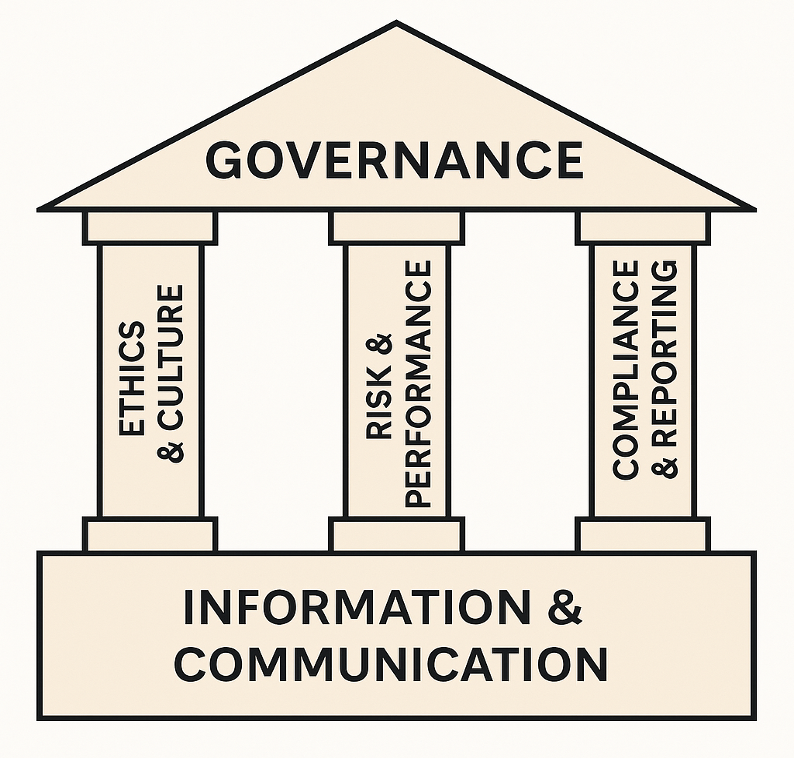
Governance is the roof, supported by Ethics & Culture, Risk & Performance, and Compliance & Reporting—all resting on a foundation of Information & Communication.
Take a look at the house.
At the top, you’ll see the roof—labeled Governance. That’s intentional. Governance is meant to sit above the rest. It’s what shelters, directs, and connects everything underneath it. It’s not one of the pillars. It’s not the floor. It’s the roofline that gives the structure form and function.
Too often, governance gets lumped in with risk and compliance like it’s just another line item or department. But let’s be clear: risk and compliance are things you do. Governance is how you decide what to do, why, and whether it’s the right thing in the first place.
The three pillars—Ethics & Culture, Risk & Performance, and Compliance & Reporting—each play a vital role. But without governance providing coherence from above, they stand like columns without a roof: disconnected and directionless.
Ethics isn’t just about intent—it’s how values manifest through behavior. That’s why ethics and culture are inseparable in any system of trust and accountability.
Risk isn’t just about what might go wrong. It’s about navigating what might happen. That’s why we frame it not just as “risk management,” but as “risk and performance”—two sides of the same strategic coin.
That’s the problem with letting GRC devolve into just another acronym. It implies parity. It suggests these elements are interchangeable or equal in weight. But governance isn’t a partner. It’s the architect. The compass. The part of the structure that makes sure the whole thing has integrity.
Some may look at the house and see permanence. But make no mistake—this isn’t a monument. It’s a structure designed to breathe, to shift, and to evolve. Especially now, with AI acting as the intelligent wiring, the house becomes less of a shelter—and more of a system. A responsive one.
And when we forget that the whole house starts to lean.
III. The Foundation Is Cracked: Why Information & Communication Matter
Most people never think about the foundation—until it fails.
You can build the most principled ethics program, design a meticulous risk framework, and have compliance policies that would make a regulator weep with joy. But if communication is weak, misunderstood, or selectively applied, the entire structure starts to buckle.
Information & Communication isn’t just the bottom of the house. It’s what holds the weight of everything else. It’s how decisions are shared. How intent becomes action. How leadership connects with reality.
Without strong, clear, and consistent communication:
- Ethics becomes performative.
- Risk becomes reactive.
- Compliance becomes confusing, or worse—weaponized.
And governance? Without communication, it becomes a game of telephone—the childhood game where a simple message, whispered from person to person, ends up completely mangled by the end.
In the COSO model, information and communication are distinct layers—kissing cousins, as some call them. But with AI, they become fused. The same intelligence that collects and structures information also determines how, when, and to whom it’s delivered. That’s not just communication—it’s orchestration.
The problem in many organizations isn’t that they don’t have governance—it’s that no one’s on the same page about what it means, how it’s supposed to work, or who’s actually holding it up. That ambiguity spreads like cracks in a foundation. Small at first, but over time, capable of collapsing the entire structure.
If we want the house to stand, we have to start beneath the surface.
IV. The AI-Powered Renovation
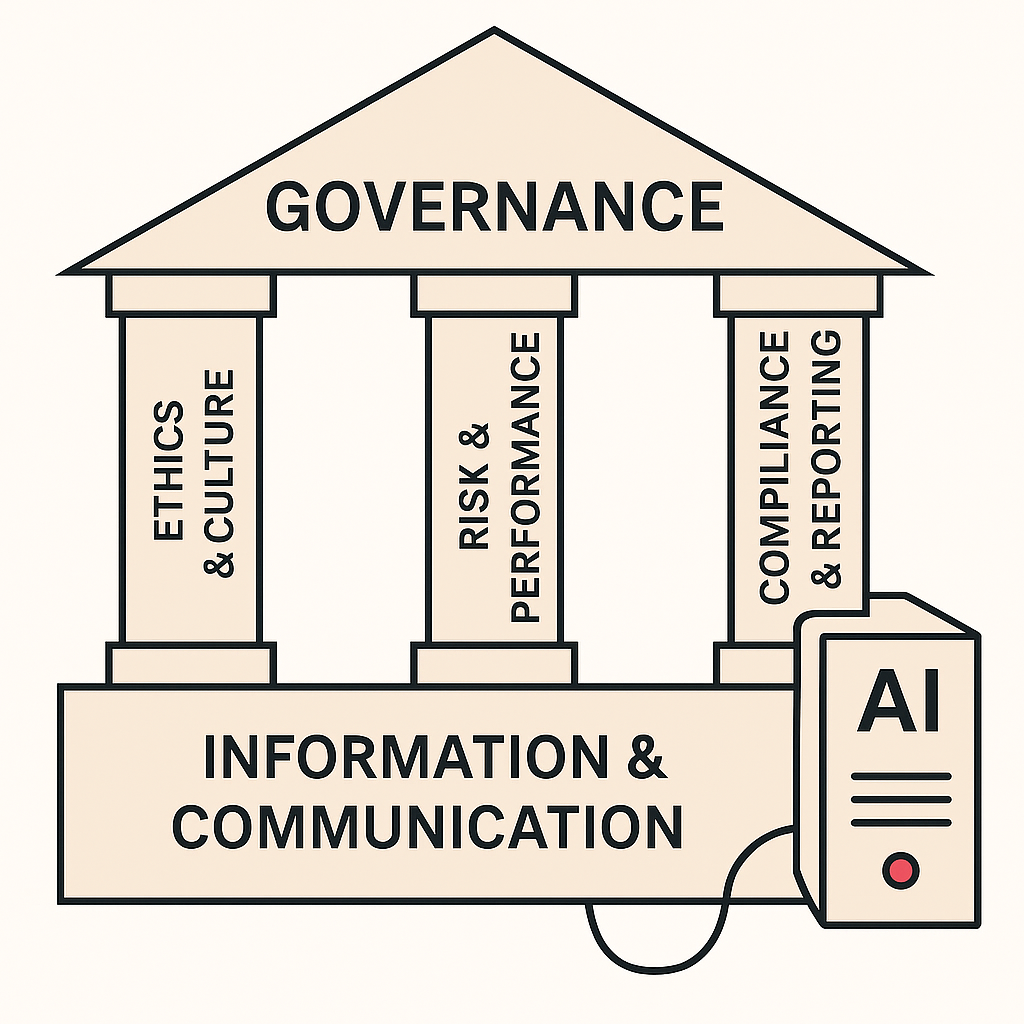
Figure 2: The AI-Supported Governance House
A single AI system supports the entire structure—connected, but not controlling.
It’s one thing to recognize the cracks in the house. It’s another to have the tools to fix them.
For the first time in a long time, we do.
Artificial Intelligence isn’t just knocking on the door—it’s standing right outside, ready to help rewire the structure. Literally.
Let’s revisit the house illustration.
Now, you’ll see something new: a computer tower marked AI just outside the structure. A single cable runs from it, connecting directly to the house—not to replace the architecture, but to support it. To amplify it. To strengthen every piece.
Because AI, when used right, does exactly that:
- It reinforces communication, turning static reports into real-time insight.
- It monitors compliance at scale, spotting gaps before they become breaches.
- It enhances risk intelligence—constantly evaluating opportunities and threats in context—so leaders can make decisions that drive performance, not just avoid pitfalls.
- It guards ethics, flagging anomalies or decisions that might violate the organization’s values.
And most importantly? It can help governance do what it was always meant to do: stay informed, stay connected, and stay ahead.
This isn’t about replacing the people in the house. It’s about upgrading the wiring so that every part of the structure communicates better, reacts faster, and stands stronger.
V. Build to Last
The debate about what to call “GRC” will rage on. Some will rebrand it. Others will add new letters until the acronym looks like alphabet soup. But if we’re being honest, none of that really addresses the problem.
The real work isn’t in the name—it’s in the structure.
Governance isn’t just a term to debate or a checkbox to tick. It’s the design, the direction, the discipline that holds the entire enterprise together. And right now, too many organizations are living in lopsided houses—good intentions propped up by brittle communication and outdated frameworks.
But that doesn’t have to be the story.
We have a chance to rebuild. To reframe governance as the roof that shelters—not stifles.
To reinforce the ethics, risk, and compliance pillars with clarity and connection.
And to strengthen the foundation of information and communication with help from a technology that’s finally ready to do more than observe.
AI is not the architect. But it can be the electrician.
It can help us power a house that’s not only sound—but built to last.