



Abstract
The traditional model of lifetime employment is gone. Today’s world of work is dynamic: industries shift, companies restructuring, jobs are in constant motion. Stability is no longer defined by employer or job title — it’s defined by you.
To thrive, you must think of yourself as the CEO of “You Inc.” Your work identity, brand, and value proposition are yours to define, develop, and market.
This guide will show you how to manage your job search like a sales process: problem definition, positioning yourself as the solution, and building strong relationships. You’ll learn how to create an accomplishment-based resume, craft powerful personal stories, network with impact, and approach interviews with confidence and purpose.
Welcome to the new job search — driven by you, powered by your personal value.
Six Phases:
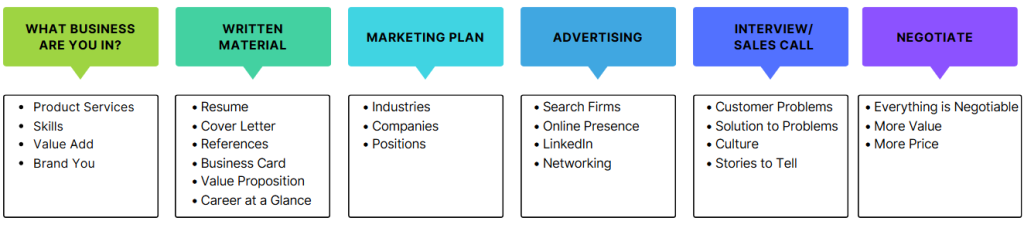
Job Search is a Sales Process
- Today’s job search is not all about filling out applications for open positions — it’s about selling yourself as the best fit to solve a company’s problems.
- Think of companies as your prospective customers. Every company has issues: operational inefficiencies, talent gaps, growth challenges, innovation requirements. Your task is to discover those pain points and present yourself as the best solution.
- The most effective way is consultative selling — not pushing yourself like a product, but intelligent questioning and active listening from the perspective of their needs.
Key Tips to Succeed in Job Search Sales Process:
- Talk less, listen more: Have a goal to talk only 1/3 and listen 2/3. Employ open-ended questions to uncover hidden needs.
- Customize your pitch: Tailor every conversation to the company’s specific challenges. Show that you’ve done your homework.
- Differentiate yourself: Offer unique insights or experiences that others can’t easily replicate. Teach them something new about solving their problems.
- Tell powerful stories: Use the SOAR framework (Situation, Obstacles, Action, Results) to craft compelling examples that showcase how you’ve solved similar problems in the past.
- Follow up personally and promptly: Send a thank-you note personally after every interaction, reminding them of the value you provide.
- Improve continuously: After every interview or networking call, ask yourself: What did I do well? What could have been better? How will I improve next time?
Remember: In the market, you are both product and salesperson. The more compellingly you demonstrate that you are able to solve their problems, the more valuable — and sought after — you are.
What Business Are You In? What is “Brand You”?
What returns and results does your company — You Inc. — provide? Don’t deceive yourself: you have much to offer. If asked by management at a potential acquisition company, “If we hired you, what would be our return on investment (ROI)?” You need to be in a position to answer confidently.
But don’t stop there. Smart leaders look at Return on Opportunity (ROO) — more growth, innovation, or competitiveness they can get by bringing the right person aboard. Companies make money to make money, but they also want to seize opportunities: taking sales higher, getting cash flowing faster, beating KPIs, growing EBITDA, expanding margins, getting quality better, doing more with less, and all of this for a lower cost.
Examples of results you can impact are reducing cycle time, saving turnover, improving operating efficiencies, minimizing rework, bettering customer experience, minimizing risk, and expanding market share.
Don’t shortchange yourself — your skill set, expertise, and perspective can yield hard returns as well as provide promise for the companies you join.
Resume (Marketing Brochure)
You want your resume to present you as an achiever, not just a doer. It should be results focused and not task oriented. You want the hiring manager to picture you delivering similar results at his/her company. You need compelling language that brings your work alive.
Examples:
- Slashed administrative cost 30% by negotiating price and fees while ensuring quality of product and services
- Reduced cycle time 15%-20% to process claims by designing, developing, and implementing a new complex claims processing system
- Increased productivity 20% and reduced cost of goods sold by using improvement tools to get a one and done manufacturing process
- Increased market share 30%-35% by implementing an online social media site
- Increased productivity 25% by restructuring a $500M business unit
- Increased EBITDA 18% by implementing a strategic cost re-structuring strategy and improving operational efficiency across four business units
- 35% profitable revenue increase by advising board and C- Suite on a $1.2B M&A strategy, including acquisition of two high growth start ups
- Drove $200M digital transformation by leading global teams across the U.S. aligning technology, finance and operations
At the C- Suite level, it’s about what you did, it’s about the business impact you implemented. No one hires the resume; jobs are found through conversations!
Questions to Ask When on An Interview / Sales Call
- What does success look like for this role in the first 90 days and in the first year?
(Shows you are proactive and eager to align with company’s expectations on day one)
- What are the biggest challenges the team is facing that as a team member I can help solve?
(Shows you are a problem solver. Demonstrates you are already thinking like part of the team)
- Is there anything about my background or experience that gives you pause about my fit in this role?
(Bold, but it opens the door to address any concerns directly and leaves no room for doubt)
- What do you personally enjoy most about working here?
(A human touch. It builds rapport and gives you insights into the company’s culture)
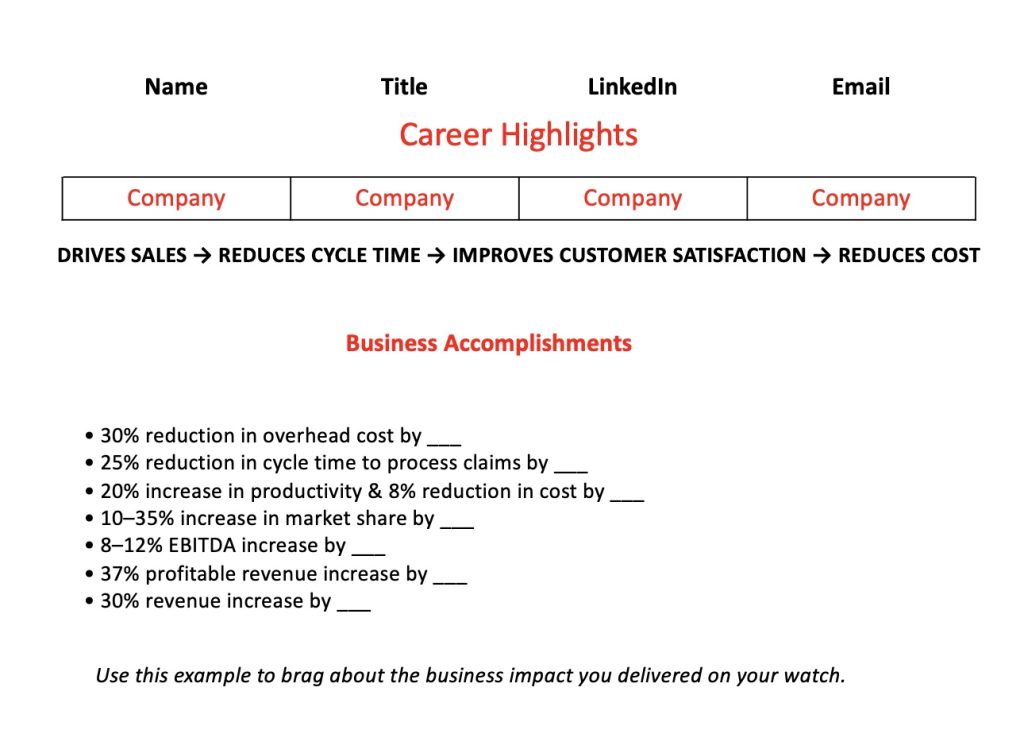
Career @ A Glance
Used at a Networking or Sales Call/Interview conversation, you do not want the hiring manager to read your resume. Use this document to easily create an open-ended conversation.
Template Examples:
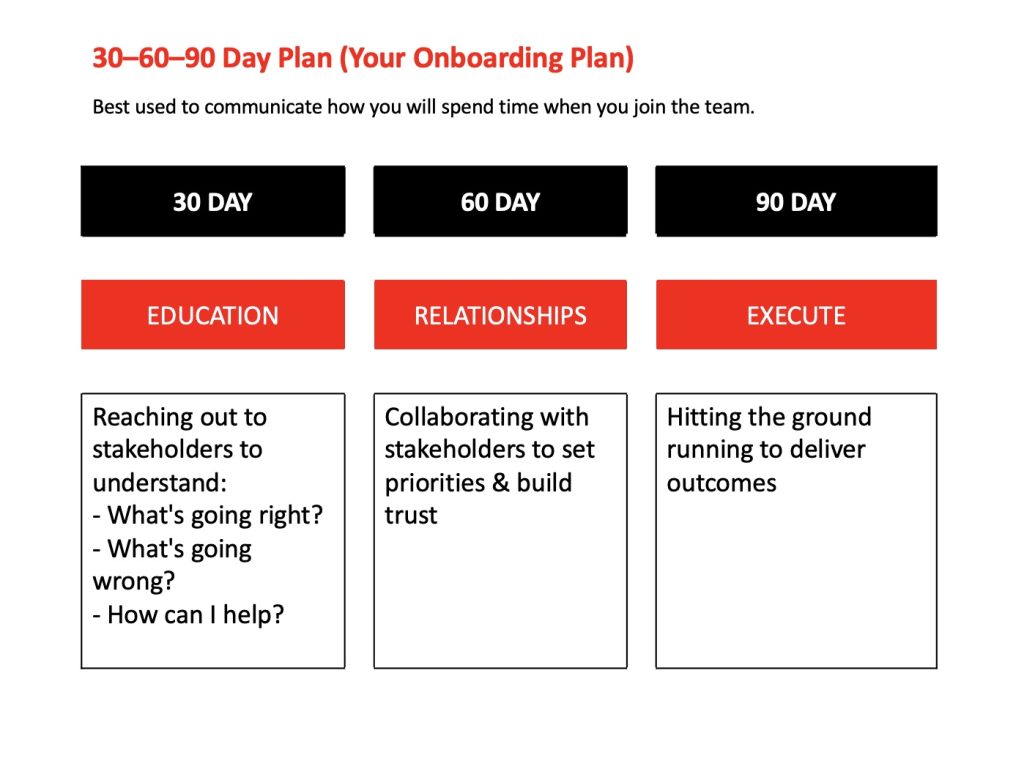
30-60-90 Day Plan (Your Onboarding Plan)
Best used to communicate how you will spend time when you join the team.
Networking Broadly
The goal is to get introductions and leverage both your personal and professional network. A lead can come from anywhere. Networking at a company doesn’t mean you want to work there.
Let the person know you are not expecting them to get you a job, rather you just want their help navigating, “Where you are, where you’ve been, and where you’re going.” Remember, always stand in front of the boat where you are going, not in the back of the boat where you came from!
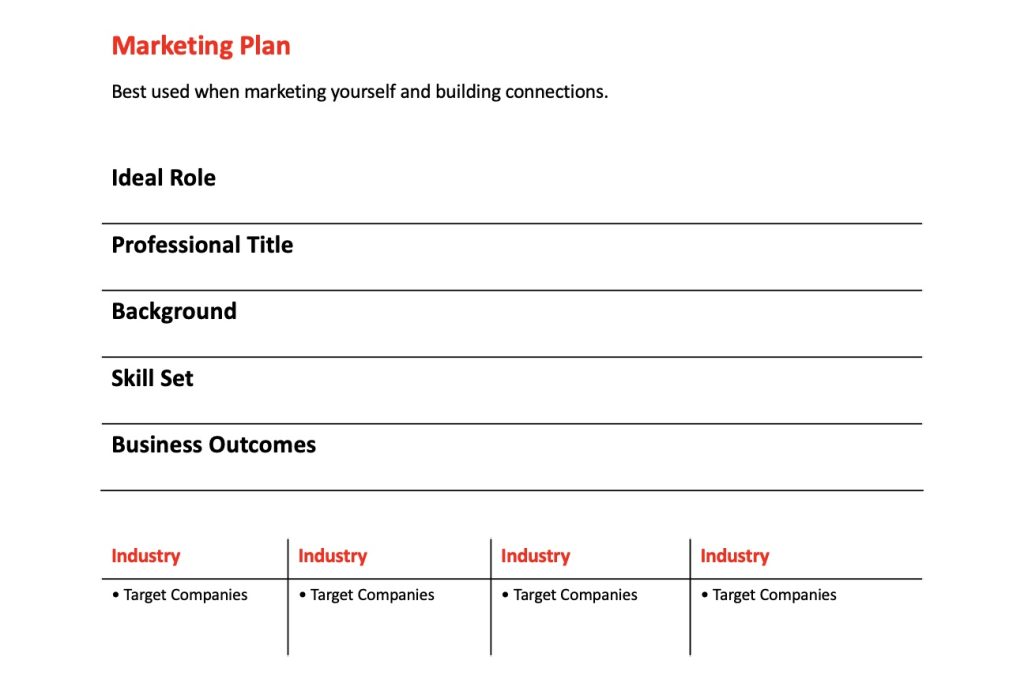
Marketing Plan
Best used when marketing yourself and building connections.
Interview and Negotiating
Remember, it’s a sales call, it’s all about them not you, you’re searching for their problems not the job. The more your potential customer believes you can help solve their problems, the more they will want you. Everything is negotiable. You create value by understanding customers, their challenges, problems and positioning yourself as the solution. The more they want you the more they will pay.
































That is a great article, Ed. Thank you.
Diane Costello
di************@*****ok.com