



Today’s cybersecurity landscape has reached a critical inflection point. Cyber Risk programs that focus on isolated technical flaws do not adequately protect businesses against today’s complex threats. Treating cyber threats as business risks—measured by impact on revenue, regulatory exposure, and operational continuity—creates a decision framework that executives can act on. This shift moves security from a compliance checkbox to a strategic lever that influences budget allocation and risk appetite.
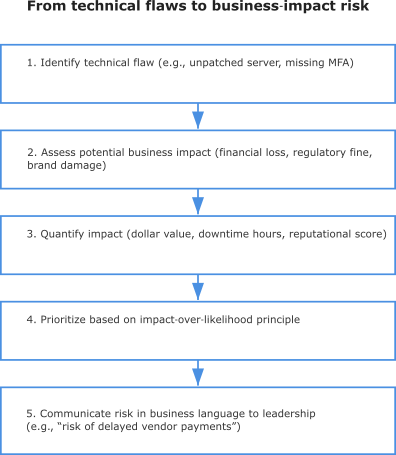
Technical flaws such as an unpatched server or missing multi‑factor authentication are temporary conditions, not risks. They become risks only when they can cause measurable business harm, like delayed payments, fines, or brand damage. Prioritizing impact over likelihood forces teams to address scenarios that could cripple core processes, rather than chasing every low‑severity alert.
Chief Information Security Officers (CISOs), should replace technical jargon with business language: “Our accounts‑payable system faces a high risk of disruption that could delay vendor payments and erode supplier trust,” instead of “There was a critical ERP CVE detected with a CVSS Score of 5.2” This translation shifts the focus and lets leaders weigh cyber risk alongside market expansion, capital projects, and talent acquisition and enables faster decision-making without unnecessary cognitive overload.
Overcoming Cultural Resistance
Security teams often view business‑risk frameworks as an oversimplification of threat complexity, while business leaders may doubt that technical details can be expressed in high‑level metrics. A hybrid approach solves both concerns. Cross‑functional workshops let engineers explain the technical dependency while business owners articulate the financial consequence. A shared risk glossary eliminates misunderstandings and builds trust.
A further way to break down resistance is to embed clear, outcome‑focused metrics into the risk process and tie those metrics to performance incentives. When security teams can demonstrate that a specific control reduced downtime by a measurable amount or avoided a regulatory penalty, business leaders see tangible value. Publishing short‑term win stories, such as a rapid patch that prevented a service interruption, creates momentum, reinforces the business‑risk narrative, and encourages wider adoption of the integrated approach.
Building Organizational Maturity
Business risk maturity grows along three axes:
- People – Cross‑train security staff in business impact analysis and teach business leaders basic cyber concepts.
- Processes – Adopt a unified risk‑assessment workflow that feeds directly into the enterprise risk register and supports continuous monitoring.
- Technology – Deploy tools that automate data collection, enable AI assistance, and deliver executive‑grade dashboards.
Investing across these dimensions creates a culture where risk is a shared responsibility, not a siloed function.
Integrating Cybersecurity into Enterprise Risk Management
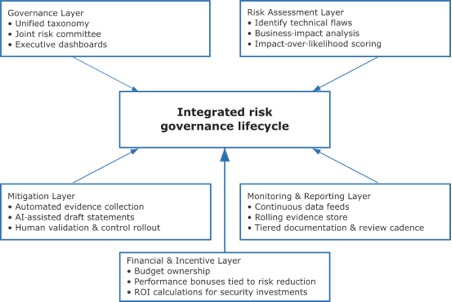
Before an organization can treat cyber threats as business risks, it must incorporate security considerations into the broader risk‑governance process. Doing so ensures that every cyber‑related concern is evaluated alongside financial, operational, and strategic risks, creating a single, coherent view for decision makers. Start by establishing:
- Unified taxonomy – Agree on a single set of risk categories, impact scales, and tolerance thresholds that span cybersecurity, operational, financial, and strategic domains. A common language prevents duplicated registers and simplifies executive reporting.
- Joint governance – Establish an enterprise risk committee that includes security, finance, and operations leaders. Integrated dashboards give the board a holistic view of all material risks, reducing the need for separate meetings.
- Framework leverage – The NIST Risk Management Framework and ISO risk‑management standards provide a proven structure that can be tailored to any industry. Their emphasis on continuous monitoring aligns naturally with a business‑risk mindset.
Financial Accountability Drives Ownership
Adding financial stakes to risk decisions turns abstract compliance into a concrete business priority. When a unit knows that its budget will absorb the cost of a breach—or that its performance bonuses are linked to measurable reductions in risk‑related expenses—it naturally starts to consider security controls through the same ROI lens it uses for any other investment. This alignment encourages leaders to fund preventive measures, negotiate clearer service‑level agreements with vendors, and prioritize remediation activities that deliver the greatest dollar‑saved impact, embedding cybersecurity into the organization’s overall financial planning cycle. This transforms security from a cost center into a budget line item that competes with other strategic investments based on business value.
Balancing Automation with Human Oversight
Automation excels at gathering evidence, correlating logs, and drafting preliminary risk statements for human review. However, regulations such as SOX, the SEC’s 2023 cybersecurity rules, HIPAA, and GLBA still require executive sign‑off on risk tolerance and remediation decisions. Therefore, the ideal workflow is:
- Automated tools collect data regularly.
- Security analysts validate the technical accuracy of the data through periodic sampling.
- Evidence of control operation is used to show the effectiveness those controls in reducing business risks.
- Business leaders review risk impacts based on defined tolerances.
- Executives sign off on risk decisions, satisfying regulatory requirements.
Documentation That Supports Agility
A risk‑based documentation approach keeps paperwork proportional to risk severity. High‑impact items receive a detailed analysis, frequent reviews, and formal approvals. Lower‑impact items use a lightweight analysis and less frequent review cycles. This tiered method preserves auditability while avoiding bottlenecks.
Because auditors often request proof of “continuous monitoring,” the risk monitoring process should incorporate a rolling evidence store. Screenshots, log excerpts, and compliance attestations should be attached to each risk record and tagged with the reviewer’s sign‑off as required. The evidence store should be searchable by risk ID, control type, or review date, enabling rapid retrieval during internal or external audits without pulling separate files.
Finally, the cadence for reviewing each risk is driven by its inherent tolerance level. Risks flagged as “high” should trigger a quarterly reassessment meeting, while “moderate” and “low” risks are revisited semi‑annually or annually, respectively. This schedule aligns the documentation workload with the organization’s risk appetite and ensures that the register remains a living document rather than a static snapshot.
Innovation Within a Structured Risk Process
Risk frameworks should enable, not block, new initiatives. An “innovation sandbox” assigns pre‑approved tolerance levels to experimental projects, allowing rapid prototyping while maintaining oversight. A short impact questionnaire—covering data sensitivity, regulatory exposure, and operational dependency—can be completed in a day or less, delivering provisional approval without a full risk assessment cycle.
Emerging‑Technology Risk Management
Artificial intelligence, IoT, cloud services, and quantum introduce interdependencies that traditional checklists miss. To manage these vectors:
- Map each new technology to the business processes it supports.
- Conduct scenario‑planning workshops that explore worst‑case business impacts.
- Blend external threat‑intel with internal telemetry to generate forward‑looking risk indicators.
These steps keep emerging‑technology risk on the same decision‑making plane as legacy systems. Emerging risks are not fundamentally different, and should be handled using the same unified enterprise risk assessment and management process as other business risks.
AI in Risk Management: Opportunities and Limits
AI can also automate evidence collection, highlight anomalous behavior, and produce first‑draft risk statements based on evidence. However, AI‑generated outputs must be reviewed before influencing budget or compliance decisions. Public AI models also raise legal‑discovery concerns; organizations should assess data‑privacy implications and consider private, vetted models for confidential risk work.
A human‑in‑the‑loop remains essential because AI lacks the contextual judgment required to weigh competing business priorities. Security analysts must verify that the data sources feeding the model are trustworthy, confirm that suggested risk language accurately reflects the organization’s operational realities, and adjust any oversights that stem from the model’s training biases. This collaborative review ensures that the final risk artifacts are both technically sound and strategically aligned.
One persistent challenge is that current laws and regulatory guidance were drafted before generative AI could author or execute an entire risk‑management program. Consequently, regulators have not issued explicit rules permitting AI‑produced risk registers to satisfy audit or reporting obligations. As a result, executives should hesitate to sign off on AI‑only outputs, as an unchecked model could introduce undocumented assumptions, expose the firm to discovery requests, or result in direct fines or criminal penalties for executives. Maintaining a clear audit trail, where every AI suggestion is logged, annotated, and approved by a qualified human, helps to build the evidentiary backbone needed to meet legal expectations while still benefiting from reasonable AI‑driven efficiencies.
Preparing for Evolving Regulation
Regulators are converging on holistic risk‑governance models that treat cybersecurity on par with financial and operational risk. Staying ahead requires:
- Ongoing monitoring of regulatory updates through industry groups.
- Flexible frameworks that allow new requirements to be incorporated without a full process redesign.
- Audit‑ready documentation that demonstrates compliance with existing statutes (SOX, HIPAA, GLBA) and emerging guidance.
Proactive alignment reduces audit surprises and strengthens stakeholder confidence.
Actionable Checklist
- Map technical flaws to business processes and state the potential financial or operational impact.
- Adopt a unified risk taxonomy that spans all enterprise risk domains.
- Maintain a single risk register capturing description, impact, likelihood, owner, and decision status.
- Define and document risk‑tolerance thresholds for each critical function.
- Assign financial accountability for risk‑acceptance decisions, insurance premiums, and remediation budgets.
- Use automation for evidence collection and initial risk drafting, but require human sign‑off for tolerance and final approval.
- Apply tiered documentation – detailed for high‑impact risks, lightweight for lower‑impact items.
- Create an innovation sandbox with pre‑approved tolerance levels to accelerate safe experimentation.
- Regularly review emerging‑technology risk through scenario planning and threat‑intel integration.
- Monitor regulatory developments and embed flexibility in governance structures to accommodate new requirements.
This checklist helps to align technical risks with business objectives, secures executive buy‑in, and satisfies regulatory expectations.
Conclusion
Reframing cyber threats as business risks is no longer optional; it is a strategic imperative. By translating technical conditions into measurable business outcomes, integrating security into enterprise risk governance, and balancing automation with human oversight, organizations turn security from a cost center into a catalyst for business resilience and growth. Leaders who adopt this integrated approach will protect critical assets, maintain operational continuity, and position their companies for sustained competitive advantage.