



What if your next earnings call success started with a leaderboard?
You know, the kind of visual graphic that ranks progress, sparks friendly competition, and keeps people coming back for more.
What if similar mechanics that drive engagement in games could also drive the KPIs that matter most to business?
Recently, the CEO of one of our customers was on an earnings call getting push back from investors on Free Cash Flow (FCF) which had dropped to about 50% coming out of their first big challenge with a major post-acquisition corporate integration.
For a company that focuses on R&D, it was critical to be able to reinvest in their business and also in their people who create their ‘next best innovations’. With Wall Street watching closely, the CEO set an ambitious goal to increase free cash flow conversion from 50% to 80% in 3 years. Let’s take a look at the effect of this real-world application.
A Shift in Leadership Mindset
A company-wide challenge called “Go with the Flow” The Free Cash Flow Challenge (FCF) was introduced and built upon a 3-part, repeatable framework that they’ve used over the years for other goals as well.
In this case, through gamification, they educated their 95,000 global employees on what FCF is, how it connects to their roles, and how they could contribute. The program reached over 90% of manufacturing employees where 61% were inspired to make a personal contribution commitment by submitting thousands of cost-saving ideas.
The impact – they hit 80% in year 1.
Interestingly, too; the biggest idea came from a plant worker that generated a multi-million-dollar innovation; something leaders admitted they “hadn’t even considered”. What’s notable as well is that gamification didn’t just drive participation, it sustained commitment, sparked innovation, and delivered measurable business impact.
But what inspired me most?
The program’s reach extended across the entire organization even to in-field, remote and offshore employees. By overcoming digital access barriers, it ensured that everyone had a voice and a stake in the outcome. This inclusivity helped unify the workforce around a single, shared goal, keeping it top of mind and a top priority for all.
Leaders were impressed by the employee response and so was Wall Street. As one leader put it:
“It got the attention of our investors.”
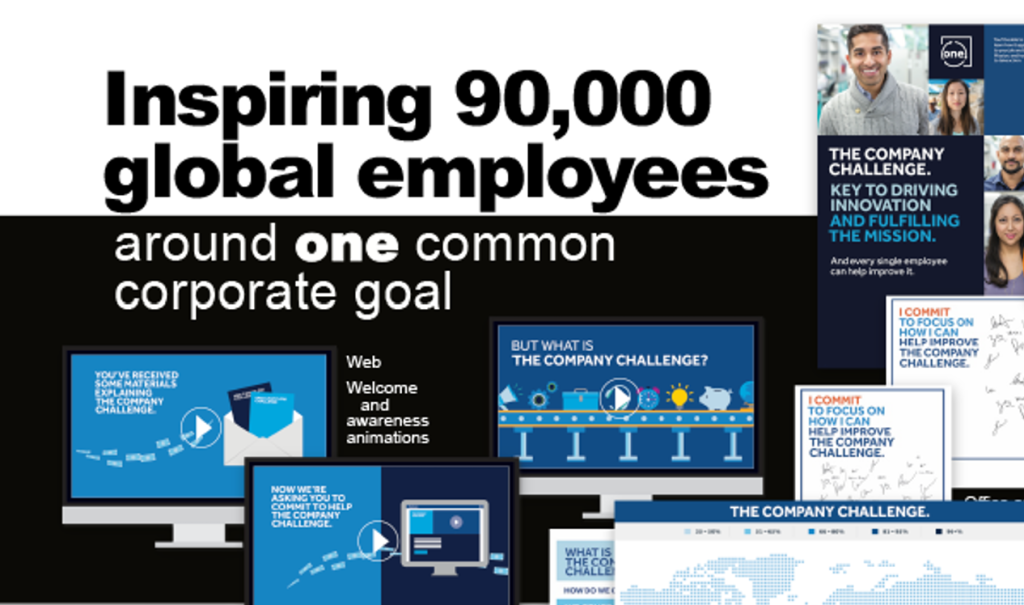
Video Link Here: Driving business and culture – BI WORLDWIDE
The core idea emphasizes a leadership mindset that values contributions from every employee, unlocking untapped potential and recognizing their role in advancing the organization’s strategic vision. What’s striking is that this isn’t just another corporate target, it marks a meaningful shift toward prioritizing people alongside metrics, which, drives stronger business performance*.
So, how do you unlock that power?
*Gallup reports that highly engaged teams show 23% higher profitability and 18% higher productivity than disengaged teams. Global Engagement Falls for the Second Time Since 2009.
The Impact of Gamification – A timely tool to sharpen focus and drive success
In today’s fast-moving, high-pressure business environment, leaders are being asked to do more with less. Teams are lean, expectations are high, and the margin for error is razor thin. So how do you get people—from the front line to the C-suite and managers in between—focused, motivated, and aligned?
One of the most effective (and often overlooked) levers of performance is also one of the most human: engagement. Not the fluffy kind. The kind that’s grounded in behavioral science and tied directly to performance. That’s what gamification does. It taps into what drives people—progress, recognition, competition, performance—and channels it toward business goals by motivating “calls to action” (CTA).
A simple example? Starbucks Rewards.
You earn stars with every purchase, unlock perks, and get nudged to act by limited time offers. It’s gamification in your pocket using progress, rewards, and a competition, against the clock, to keep you coming back.
Now apply that same idea to the workplace.
Imagine a sales team earning points not just for closed deals, but for key behaviors such as logging calls, setting face-to-face meetings, landing new and/or national accounts or completing training. As they hit milestones, they unlock rewards, climb leaderboards, and see their progress in real time. It’s not just about incentives, it’s about creating momentum, visibility, and a sense of achievement that keeps people engaged and focused. When employees see their progress and feel rewarded, they become inspired, stay engaged and keep performing. Why?
Gamification taps into the right-brain.
Personally, I like to think of gamification as a “mental coffee break.” “In a nonstop work environment—where teams stretch across time zones and days are packed with dashboards, data, and digital demands—it provides a much-needed and refreshing reprieve.
Gamification activates the right side of the brain where most decisions are made delivering a quick, energizing boost of interest and intrigue. It sharpens focus, makes tasks more enjoyable, and yes, it can make work more fun with game mechanics. Honestly, I’ve never seen an employee who isn’t more productive when they’re genuinely engaged in their work.
You might be thinking: Why should we motivate people to do their jobs? Isn’t that what a paycheck is for?
Fair question. But here’s the reality: employment is at-will and so is commitment.
As Compensation and Total Rewards leaders well know, comp plans get people in the door, but they don’t always keep them engaged, focused, or performing at their best. This has become more of a conundrum in our multi-generational workforce.
Why Gamification Matters for Gen Z and Millennials
Gamification is especially powerful in engaging Gen Z and Millennials, the generations often labeled as “job hoppers” due to their desire for more balance as well as growth, feedback, and purpose. There is significant data that proves these employees aren’t lazy or disengaged; they’re disconnected by outdated systems that don’t reflect how they learn, compete, or thrive.
With Millennials and Gen Z now making up over 50% of the U.S. workforce, according to the US Bureau of Labor Statistic, (Millennials at 36% and Gen Z at 18% and rising),Corporate America may fare well to embrace gamification tactics to engage these digital natives described as “mobile first” who thrive in an interactive, goal-driven environment. www.bls.gov/emp/tables
Why Gamification is Meaningful for Gen Z and Millennials
- Gen Z and Millennials value purpose, feedback, and growth.
- Gamification provides real-time recognition and progress tracking.
- It transforms routine tasks into engaging challenges.
- Builds emotional connection and can improve culture.
- When used strategically, it can align individual effort with organizational KPIs.
Gamification taps into their natural drive for progress, recognition, and community by turning work into a series of meaningful challenges and rewards. When designed strategically, it creates a sense of belonging, achievement, and visibility.
Three critical factors that can reduce turnover and unlock discretionary effort -extra energy, creativity, and commitment.
Employees choose to give when they feel inspired, challenged, and connected to a goal. For organizations, this means transforming short-term engagement into long-term performance and retention.
Moving the Middles
The real payoff?
Intrinsic motivation: the internal drive to act because something feels meaningful or satisfying. It taps into the right side of the brain, where creativity, emotion, and purpose live.
When employees are intrinsically motivated, they don’t just complete tasks, they care about the outcome.
That’s what drives consistent, higher-quality performance.
Lastly, too often, many incentive programs only reach the top performers; the already motivated few. But when structured correctly, gamification engages “the middles” (60% of the workforce as diagramed below), where the biggest capacity of opportunity for performance lift lives. That’s not just engagement. That’s impact.
Design for Incremental Performance
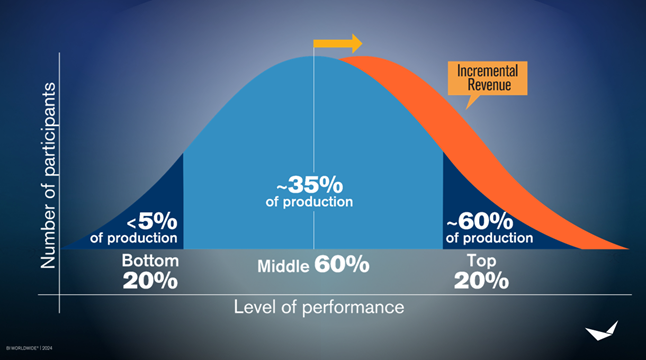
Gamification taps into that space of discretionary effort. It doesn’t replace accountability, it enhances it. By making progress visible, rewarding consistency, and creating a sense of momentum, it helps people stay engaged in the work that matters most. And when engagement goes up, performance follows.
Real-World Applications
Sales – Manufacturing
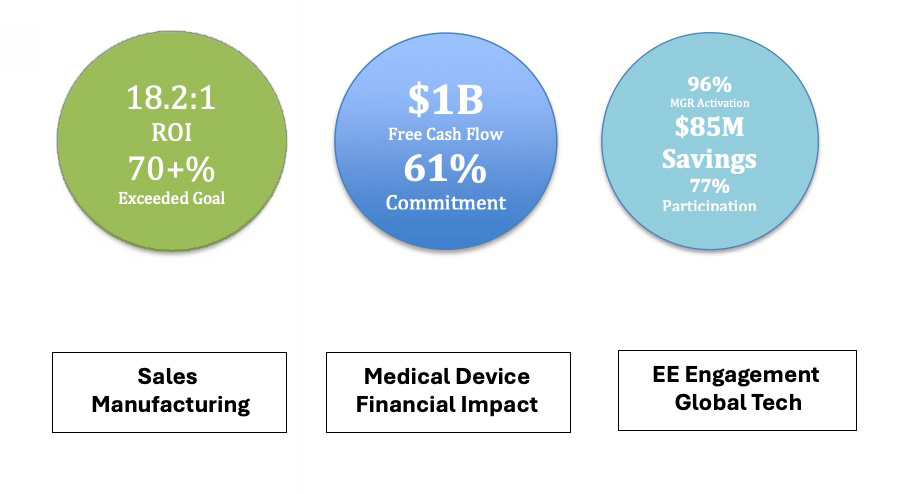
A leading HVAC manufacturer used BI WORLDWIDE’s GoalQuest® platform to launch a 3-month sales promotion. By gamifying growth targets and offering self-selected tiered rewards, they saw a double-digit increase in sales, with over 70% of participants exceeding their goals. The competitive structure kept teams engaged, energized, and focused through the end of the fiscal year. Despite a lofty goal, 84 winners earned the top-level award, more than 3x the number in previous programs. The client showed an 18.2:1 ROI on this program.
Financial Impact – Medical Device
A global medical device company implemented a gamified performance initiative aimed at improving operational efficiency and alignment across teams. By focusing on behavior-based engagement and recognition, the company unlocked over $1 billion in free cash flow, demonstrating how strategic motivation can directly influence financial outcomes at scale.
Employee Engagement – Global Tech
A multinational technology services and consulting company consolidated over 280 recognition programs into a single, gamified platform and realized cost savings of $85M. By introducing points, badges, and milestone rewards, they created a consistent, engaging experience for over 300k employees across more than 100 countries. As a result, 96% of managers actively recognized their teams, with a 77% employee participation rate. The company reported a 10:1 return on engagement—proving that when recognition is meaningful and visible, performance follows.
From Trend to Transformation: How Gamification Is Powering Enterprise-Wide Performance
According to recent market data, 62% of Fortune 500 companies and over 70% of Global 2000 enterprises have adopted gamification in some form to drive performance and engagement. (https://gitnux.org/gamification-statistics)
While gamification initially gained traction in employee training and development, its application has expanded significantly.
Today, customer-facing platforms and a growing number of sales organizations embed game mechanics to boost motivation, productivity, and customer loyalty. (https://www.enterpriseappstoday.com/stats/gamification-statistics.html)
This level of adoption says a lot, in that, it’s not just a trend, it’s a signal that gamification is a viable, proven strategy for influencing behavior at scale and at a strategic enterprise level.
So, whether you need to drive bottom line P&L cost savings, greater synergies across applications or accelerate KPI results, gamification can help.
When designed well, gamification aligns individual actions with enterprise KPIs, creating a culture of performance that’s measurable, scalable, and impactful. It not only makes tasks more enjoyable, but it also makes progress visible, momentum sustainable, and KPIs more achievable.
The Impact
The Cost of Disengagement
According to Gallup, only about 23% of employees globally are engaged at work. Disengaged employees are less productive, more likely to leave, and less aligned with company objectives. For large enterprises, this translates into millions in lost productivity and higher turnover costs—both of which directly affect the bottom line.
Real Results, Real ROI
Gamification isn’t just engaging—it’s effective and used to drive measurable outcomes. Real-World Application Examples:
Takeaway for Financial Leaders
As a financial executive, your role is to drive performance, manage risk, and deliver results. Gamification is a proven, scalable strategy that helps you do all three by influencing behavior in a way that’s measurable, sustainable, and human.
So, the next time your team needs a boost, skip the extra coffee run. Apply the principles of gamification instead. It might just be the most energizing strategy that you haven’t fully tapped into yet.
Pro Tip: Every gamification program is unique, but all gamification programs exist to motivate the people participating to increase adoption, engagement, and retention.
To be effective, as stated by Gartner, “Organizations must recognize that simply including game mechanics is not enough to realize the core benefits of gamification.”
As behavioral science and gamification experts often emphasize, “There is no gamification without goals.” Without a clear objective, gamification loses its power—goals provide the structure, purpose, and measurable outcomes that turn engagement into performance.
I invite you to learn the core principles of Gamification to optimize the tool and maximize business results.



























Great article, I learned a ton. Logically, involved and motivated people will perform better. They will care more, and recognition is so important. It’s not just a paycheck, it’s what we do, where we connect (whether virtual or in person), and where we spend so much of our time. I hope all companies recognize the actual value of their people. That will be a better ROI in dollars and manpower. It sounds like you are a great person to talk to about this.