



The Problem No One Is Talking About
If you log onto LinkedIn right now, you’ll see dozens of posts promising that “AI can build an entire app for you in 5 minutes.”
They aren’t lying. AI can build an app in 5 minutes. But that is exactly the problem.
We have entered an era where writing code is no longer a competitive advantage. When the barrier to creating software drops to zero, the market instantly floods with millions of generic, easily replicable toys. In an economy where attention is the absolute scarcest resource, building “just another app” is a guaranteed path to obscurity.
The fatal mistake most founders make right now is starting with the tool instead of the problem. They rush to build conversational chatbots or AI video avatars simply because the technology is novel, hoping users will show up for the gimmick. But novelty fades fast. What persists is utility: solving a genuine, validated problem better than the alternatives.
But here is the deeper insight that almost no one is discussing yet: As software creation becomes trivially easy, the demand from users will not become simpler. It will become more customized. Human demand for tailored specific solutions is effectively infinite. In education, for example, my students don’t want a generic “finance quiz app.” They want a platform built precisely against the SJSU Fin170 syllabus, with questions that directly prepare them for their specific exams. Another professor at another university teaching a different curriculum would need an entirely different product. Each use case is distinct, and no single out-of-the-box solution will serve all of them well.
This creates a profound scaling challenge for generic AI products: as everyone gains the ability to build, the market will increasingly reward hyper-specific, deeply customized solutions over broad, shallow ones. Building those customized solutions demands more skill, not less. You need someone with professor-level domain expertise to understand the student workflow, verify the accuracy of every answer, and build the product against an already-created, battle-tested curriculum. In my case, that curriculum was the workbook I wrote for my book, “The 10 Laws of Finance.” The AI couldn’t have written that book, designed that course, or verified those proofs. It could only help me deploy them at scale.
To cut through the noise, you must invert the model: Start with deep, validated market demand, and use AI solely as an execution engine to meet it faster than your institutional competitors ever could.
Why I Wrote “The 10 Laws of Finance”
I wrote “The 10 Laws of Finance” because I lived them. I went from being homeless and broke to managing multi-billion dollar deals at Google. Along that journey, I discovered that the fundamental laws governing personal financial success are the exact same laws governing corporate finance. The tools don’t change, just the zeros. The same principles of compounding, risk management, capital allocation, and financial discipline that took me from nothing to financial independence are the same ones Fortune 500 CFOs use to manage balance sheets.
I wrote the book to show students this truth, and I built the Fin170 course at San Jose State University around it. When I decided to build a digital platform to extend that curriculum, I needed it to reflect that same rigor and practicality.
1. Respect the Market, Not the Hype
Before writing a single line of code, I surveyed my finance students. Assuming they’d want the latest EdTech trend, I asked them about conversational “AI tutors,” generated video avatars, and interactive chatbots.
They unequivocally rejected all of it. Over 90% of 150 students explicitly stated they did not want to talk to a chatbot. 83% told me what they actually wanted was a rigorous, highly structured multiple-choice test banks with mathematically detailed, step-by-step explanations for every single answer option, both correct and incorrect. A portion even asked for printable formats for tactile studying.
This finding runs counter to the prevailing industry narrative that “conversational AI” is the future of education. For complex, quantitative domains like finance, law, or medicine, students don’t want to chat about concepts. They want to drill them under exam-like conditions and understand precisely why they were wrong.
How This Applies to Your Business:
Before you build anything, survey your actual users. Don’t ask them what technology they want; ask them what problem they need solved. In my case, the answer was clear: students wanted a study tool that could compete with or outperform expensive institutional platforms like Becker CPA Review or CFA Institute prep, without the $2,000+ price tag. That was the signal in an AI ocean of noise.
2. Choosing the Right AI Tool: Chatbot vs. Agentic AI
This distinction is critical, and most professionals don’t understand it yet.
A standard AI chatbot (ChatGPT, Gemini, Claude in chat mode) is a conversational interface. You type a prompt, it returns text. You copy that text, paste it into a file, manually check it, manually place it into your codebase, and repeat. It is an intelligent assistant, but it operates in a vacuum. It cannot see your files, navigate your project structure, run terminal commands, test code, or deploy your application.
An agentic AI tool operates fundamentally differently. It has persistent access to your entire codebase. It can read files, write files, execute terminal commands, run build processes, open a browser to visually test UI changes, and take screenshots for verification. Instead of generating isolated text snippets, it operates as a senior engineering partner embedded directly inside your development environment.
Several agentic AI tools are emerging in this category, including Google DeepMind’s Antigravity (which I used for this project), Cursor, Windsurf, and Claude Co-work. Each has different strengths, but they share the core principle: the AI operates inside your project, not in a separate chat window.
Here is what the difference looks like in practice:
With a chatbot, building a 50-question test bank would require:
- Prompt the chatbot to generate questions.
- Copy the output manually.
- Reformat it into the correct JSON structure.
- Paste it into the correct file in your codebase.
- Manually register the new file in the app’s data registry.
- Manually rebuild the app to check for errors.
- Open the browser and manually check for visual bugs.
- When something breaks, describe the error in text and hope the chatbot understands.
With an agentic AI, that same task looked like this:
- Describe the requirement in plain language while directing it to a folder that contains your test bank.
- The agent autonomously generates the JSON data, writes it to the correct file path, registers it in the application’s exam registry, rebuilds the app, opens a browser, navigates to the new module, clicks through questions, and reports back with screenshots confirming everything renders correctly.
An agentic tool compresses what would be hours of manual glue-work into minutes of autonomous execution.
How This Applies to Your Business: If you are still using chatbots to generate code snippets and manually pasting them into files, you are operating at a fraction of your potential speed. Evaluate whether an agentic AI tool is available for your domain. The productivity multiplier is not 2x or 3x. For complex, multi-file projects, it is closer to 100x.
3. The Tech Stack (Explained for Non-Technical Leaders)
To deploy a solution that scales globally without requiring an IT operations team, we used a modern, “serverless” stack. If you are non-technical, here is what each component does and why it matters:
- React (The Interactive Layer): React is a tool created by Meta (Facebook) that makes websites feel like apps. On a traditional website, every time you click a button, the entire page reloads from scratch. React eliminates that. When a student selects answer “C” on a quiz, only the relevant part of the screen updates instantly, showing the explanation without any loading delay. This is the same technology behind Instagram, Netflix, and Airbnb.
- Next.js (The Framework): Next.js is built on top of React and adds critical infrastructure. Think of React as the engine of a car and Next.js as the entire vehicle around it: the chassis, the navigation system, the fuel injection. Next.js handles things like page routing (making sure /quiz/test-1/chapter-3 loads the right content), search engine optimization (so Google can find the site), and server-side performance optimizations that make the site load faster worldwide.
- TypeScript (The Safety Net): TypeScript is a stricter version of JavaScript that catches coding errors before the app is deployed, rather than letting users discover them. When managing 500+ questions across 7 test banks, TypeScript prevents entire categories of bugs (like misspelled data field names) from ever reaching production. Think of it as spell-check for code.
- Tailwind CSS (The Paint): This is the styling tool. Instead of writing thousands of lines of custom, brittle design code, Tailwind provides pre-packaged aesthetic building blocks. It allows you to make an app look beautiful and professional in a fraction of the time it would take with traditional design coding.
- Vercel & GitHub (The Pipeline): Vercel is the modern hosting platform that puts the website on the internet securely. GitHub is the cloud repository where the code lives and where every change is tracked with full version history. Together, they create continuous deployment: the moment you save an update to your code, Vercel detects it and updates the live website globally within seconds. This means there is no manual “upload to server” step. You push code, and the world sees it.
- Zustand (The Session Memory): When a student builds a custom quiz by selecting specific topics, or crosses out wrong answers using the strikethrough feature, the app needs to “remember: those choices during their session. Zustand is a lightweight tool that manages this temporary memory. When you close the browser tab, this session memory resets, which is by design, as it keeps the app fast and simple.
- Local Storage & Spaced Repetition (The Study Brain): The app stores each student’s progress, scores, and study streaks directly inside their own browser. This is a deliberate architectural choice. I specifically opted against using a cloud database (like Supabase or Firebase) because storing student data on external servers would require a formal security review and data privacy compliance process. As a finance professional, not a full-time software engineer, I wanted to ensure no student’s personal information was ever at risk. By storing everything locally in the browser, students’ data never leaves their device. The trade-off is that if a student switches devices, their progress doesn’t sync. For this stage of the product, that was an acceptable and responsible decision. On top of this local storage, I built a custom spaced-repetition algorithm. This algorithm is based on SM-2, a well-researched cognitive science technique. It works by automatically resurfacing questions a student previously got wrong at increasing intervals: after 1 day, then 2 days, then 4 days, then 8 days. This spacing forces the brain to actively recall information right before it would be forgotten, dramatically improving long-term retention.
How This Applies to Your Business: You do not need dedicated server farms or DevOps engineers. By choosing a serverless stack, you only pay for the exact computing power you use. The entire infrastructure cost for this project is effectively zero at the current usage tier. And when it comes to handling user data, it is far better to make a conservative, privacy-first architectural decision than to build fast and expose your users to risk. You can always add cloud sync later when you have the resources for a proper security review.
4. Commanding the Aesthetic Standard (And Why Iteration Matters)
If you vaguely ask an AI to “build a quiz interface,” it will default to the most statistically average representation it knows, usually a clunky academic portal from 2005. In today’s attention economy, poor design kills trust instantly.
I explicitly commanded the aesthetic standard from the very first prompt:
The Initial Prompt I Used:
“We are building the UI for a financial test bank. I want a ‘World-Class’ design language. The user should be wowed at first glance. Use best practices in modern web design: a sleek dark mode with vibrant amber accents, smooth glassmorphism gradients, and subtle micro-animations for interactions. Use the Inter font for body text and Outfit for headings. Do not use generic colors; everything must feel premium.”
But here is what most AI guides fail to mention: that initial prompt was just the starting point. The aesthetic you see in the final product was not the result of one magical prompt. It was the result of hours of iterative refinement: back-and-forth dialogue where I reviewed what the AI built, identified what felt off, and asked for specific adjustments. I asked for color-coded score badges (green for 80%+, amber for 60%+). I asked for confetti animations when students answer correctly. I asked the AI to research similar best-in-class educational interfaces and incorporate those patterns. I directed mobile-responsive layouts, floating navigation bars, and keyboard shortcut support (A-D for answer selection, arrow keys for navigation).
This iterative process, which spanned a couple of hours for the core aesthetic alone, is essential. The AI generates; you direct. Think of it like working with a talented but literal junior designer. They will execute exactly what you ask for, but they need your taste, your judgment, and your willingness to say, “not quite, try this instead.”
Below is the resulting Practice Exams dashboard, built through that iterative process:
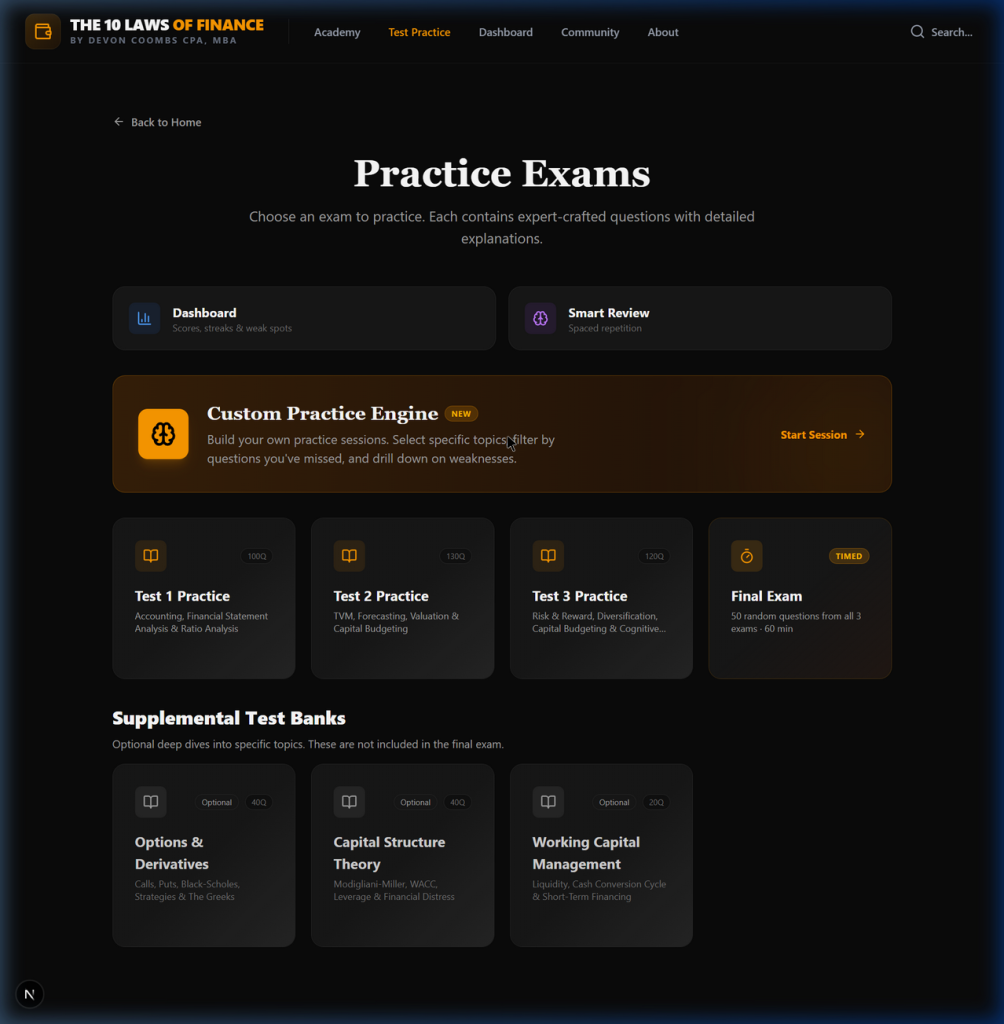
How This Applies to Your Business: Do not expect perfection from a single prompt. Budget time for iteration. The most compelling AI-built products are the result of sustained creative direction, not one-shot generation. Treat the AI as a tireless junior team member who needs your taste and strategic vision to produce exceptional work.
5. Your Expertise is the Only Moat
The most critical part of building an authoritative application is ensuring the underlying data is unimpeachable. I did not rely on AI to generate financial curriculum from scratch.
Your domain expertise is your only defensible moat. I provided my personal draft multiple-choice questions, material I had originally created, tested in live classroom settings, and personally verified for my SJSU Fin170 course. Each question was grounded in the principles of my book, “The 10 Laws of Finance,” and the workbooks I had already developed for the course. I then utilized the AI strictly as an advanced data-formatter and secondary validation layer.
The Initial Prompt I Used for Data Structuring:
“Read these draft multiple-choice questions from my Fin170 course. I need you to generate a strictly typed JSON array for our web app infrastructure. Every question must have an ID, a difficulty level, a correct answer, and a deeply nested explanations object that provides a granular, mathematical breakdown of WHY each option is right or wrong based on the provided logic.”
Again, this initial prompt was followed by extensive review cycles. I personally checked every generated explanation for mathematical accuracy, conceptual precision, and pedagogical clarity. The AI’s role was to take my vetted content and structure it into the precise data schema our frontend required, not to invent the content itself.
Below is a live question from the Personal Finance & FIRE module, showing the premium UI rendering the structured data:

How This Applies to Your Business:
Never outsource your core intellectual property to a generalized model. AI models are trained on averages; your competitive advantage lies in your specific, hard-earned knowledge. Provide the absolute ground truth yourself, and leverage the AI to structure, format, and deploy that truth at a scale you couldn’t achieve manually.
6. The Build Process: Planning Before Execution
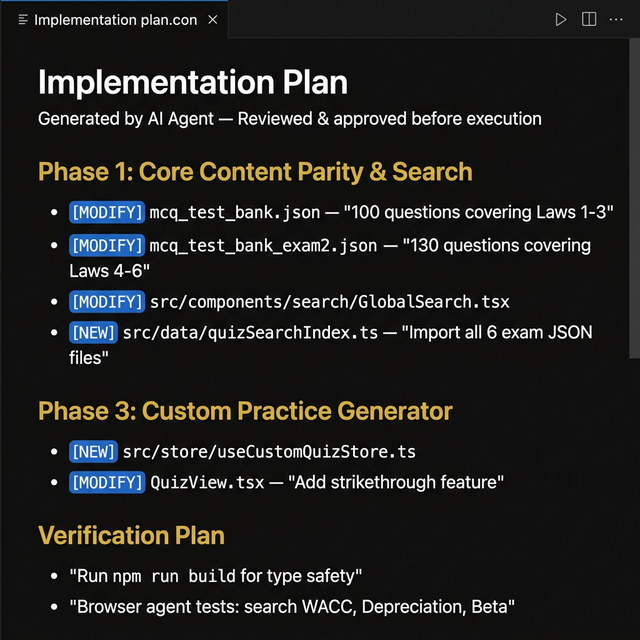
One of the most valuable aspects of working with an agentic AI is its ability to generate structured implementation plans before writing any code. Before each phase of our build, the AI produced a detailed plan document specifying every file to be created or modified, the precise data schema changes required, and the verification steps to confirm success.
This mirrors how a senior engineering team operates: you write a technical design document, get stakeholder sign-off, and then execute. The AI followed this exact workflow. I reviewed and approved each plan before greenlighting execution. There were four distinct phases:
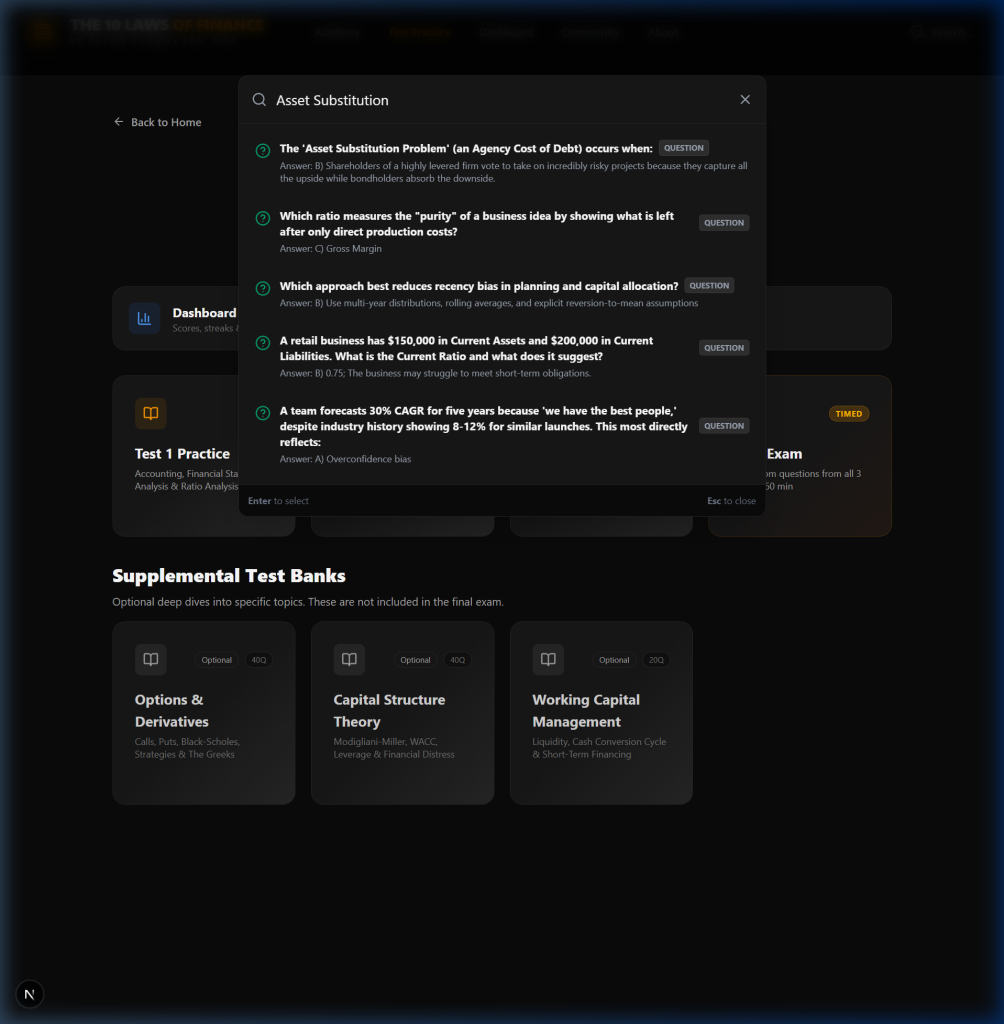
Phase 1, Core Content Parity & Search: Auditing and rewriting 230 explanations across the first two test banks to enforce rigorous, formula-based logic. Building a global search index across all 450+ questions so students can query any topic instantly.
Phase 2, Optional Test Banks: Extending the same rigorous explanation standards to 80 additional questions covering Options & Derivatives, Capital Structure Theory, and Working Capital Management.
Phase 3, Custom Practice Generator: Building a dynamic quiz builder where students can select specific topics, filter by previously missed questions, choose session sizes (10, 20, 30, or MAX), and generate custom practice exams on demand. This also included the “Strikethrough” feature, where students can right-click any answer option to visually cross it out, mimicking a physical test-taking strategy.
Phase 4, Personal Finance Supplement: Adding a 50-question masterclass module on modern personal finance topics: Budgeting & Debt Management, Retirement Accounts & Tax Strategy, Investing Basics & Dollar Cost Averaging, Real Estate & Insurance, and the FIRE Movement.
Each phase was scoped, reviewed, approved, executed, and verified before moving to the next. This prevented scope creep and ensured every component met the quality bar before being deployed to production.
Below is a representation of the actual implementation plan the AI generated before execution began. Notice the specificity: every file is named, every modification is tagged, and the verification steps are defined upfront.
Below is the global search in action, showing how a student can query “Asset Substitution” and instantly surface specific practice questions across every test bank:
How This Applies to Your Business: Resist the temptation to let AI just “start building.” Demand a plan first. Review it. Challenge it. This upfront investment in planning prevents expensive rework and ensures alignment between what you envisioned and what gets built.
7. Human-In-The-Loop (HITL) Collaboration: The Non-Negotiable
This is where 90% of automated projects fail. In fields like finance, accounting, or law, factual or structural hallucinations are not minor inconveniences. They are fatal to credibility. You must act as the Domain Expert Director, while the AI acts as the Execution Engine.
Over the course of this project, we encountered dozens of issues that required human judgment to resolve. Below are three collaboration strategies that proved essential, each illustrated with one representative example from our build:
Strategy 1: Visual Debugging (Show, Don’t Tell)
When a visual layout breaks, trying to describe the problem in text often leads to endless, circular prompt loops. The AI guesses at what you mean, makes a change, and the change creates a new problem you then have to describe again.
The breakthrough was simple: upload a screenshot of the broken UI directly into the chat. Agentic AI tools with visual understanding excel at spatial reasoning. By “seeing” the exact misalignment, the AI can instantly diagnose CSS conflicts, padding overflows, or component hierarchy issues.
- Example from Our Build: When the Options & Derivatives module overflowed its container on mobile screens, I took a screenshot of the broken layout and uploaded it. The AI immediately identified a flexbox constraint conflict and supplied the exact code fix. No back-and-forth required.
Strategy 2: Schema Patching via Autonomous Scripts
When data structures don’t perfectly align with what your frontend expects, massive parts of your application will fail silently. Features simply vanish with no error message.
Instead of manually editing hundreds of data points, explain the structural mismatch to the AI and ask it to write a utility script to fix it across the entire database autonomously.
- Example from Our Build: While migrating 50 Personal Finance questions into the app, the UI failed to render answer explanations. Investigation revealed the AI had formatted the data using an “is Correct” Boolean, but our front-end component strictly expected a “verdict” string. Instead of manually editing 200+ nested data objects (50 questions x 4 answer options each), I described the mismatch. The AI wrote a one-off utility script, executed it, and re-mapped the terms across the entire database in under two seconds.
Strategy 3: The Absolute Authority on Truth
AI is brilliant at formatting, structuring, and deploying at speed. But you are the final gatekeeper of factual accuracy. In a finance context, this means every formula, every ratio, every regulatory reference must be verified by a human with domain credibility.
- Example from Our Build: As a CPA, I rigidly audited all generated quantitative proofs. When working capital calculations needed refinement, I didn’t just correct the output. I forced the AI to state its logical algebraic steps sequentially, exposing the reasoning chain. This allowed me to verify not just the answer, but the methodology, ensuring the platform logic was bulletproof for all future content.
How This Applies to Your Business: If you are in any regulated, technical, or high-stakes domain (finance, healthcare, legal, engineering), HITL is not optional. It is a professional obligation. Build your workflow around the assumption that the AI will make structural errors, and design verification checkpoints into every phase.
8. The Result
The finished platform is live. It serves San Jose State University Fin170 students with:
- 500+ rigorously verified multiple-choice questions across 7 test banks
- Detailed mathematical explanations for every correct and incorrect answer option
- A Custom Practice Engine allowing students to build targeted study sessions from any combination of topics
- A Spaced Repetition Study Engine that automatically resurfaces missed questions using SM-2 intervals
- Global Search across all questions, allowing instant access to any concept
- A Progressive Web App (PWA) that students can install on their phones for offline, app-like access
- Deployed globally on a custom domain via Vercel with Vercel Analytics
- Zero infrastructure cost at the current usage tier
Conclusion: The New Rules of Building
We are moving rapidly out of the phase where simply “using AI” is impressive. Everyone has access to the same models, the same chatbots, the same code generators. We are entering an era where AI is the baseline expectation, and execution against real market problems is the only metric of success.
As the barrier to building software continues to fall, the winners will not be the people who can generate the most code the fastest. They will be the subject matter experts who combine deep, hard-earned domain knowledge with AI’s rapid execution to build hyper-specific solutions that generic platforms cannot replicate. The demand for these customized solutions is infinite. The supply of people who can build them with authority and accuracy is not.
By combining domain expertise with an agentic AI’s rapid execution speed, you can ship enterprise-grade tools that dramatically outperform legacy systems, in weeks, at near-zero infrastructure cost.
Start with the market problem. Dictate your standards explicitly. Plan before you execute. Iterate relentlessly. Verify everything. Assume absolute authority over the truth.
AI is the engine. You are the architect.
See It Live
The platform is live and free to explore. Test it yourself and see the principles in this paper in action: course.devoncoombs.com/quiz