



Last month, I wrote about Claude Cowork, OpenAI Codex, and Skill Packs. Angela Liu and I also covered deeper dives of this on the Gaapsavvy podcast (Claude & Antigravity). My intent for those articles and podcasts was to show you the potential impact of one tool, used well, along with how to begin implementing those tools for your teams. I take a different approach in this article, where I will cover the breadth of all of the key AI updates that impact applied business use-cases, while stressing the urgency to begin to understand these updates and utilize these tools. The AI landscape has shifted more in the past two weeks than in the previous two months, and this exponential trend does not have any indicators of slowing down, especially for applied business use cases. If you are a finance or business leader trying to figure out where to place your bets, you need a clear picture of what has actually changed and what it means for the way your teams work.
The biggest headline is that Anthropic has confirmed Claude Mythos, a new model so capable that the company chose to restrict its release and partner with Amazon, Apple, Microsoft, and others on a defensive security initiative called Project Glasswing. Meanwhile, OpenAI closed the largest venture round in history, Google released a free AI design platform and a new family of open-source models, and the open-source frontier advanced to the point where a Chinese lab’s free model now outperforms last month’s best proprietary offerings on coding benchmarks.
The Super App Thesis
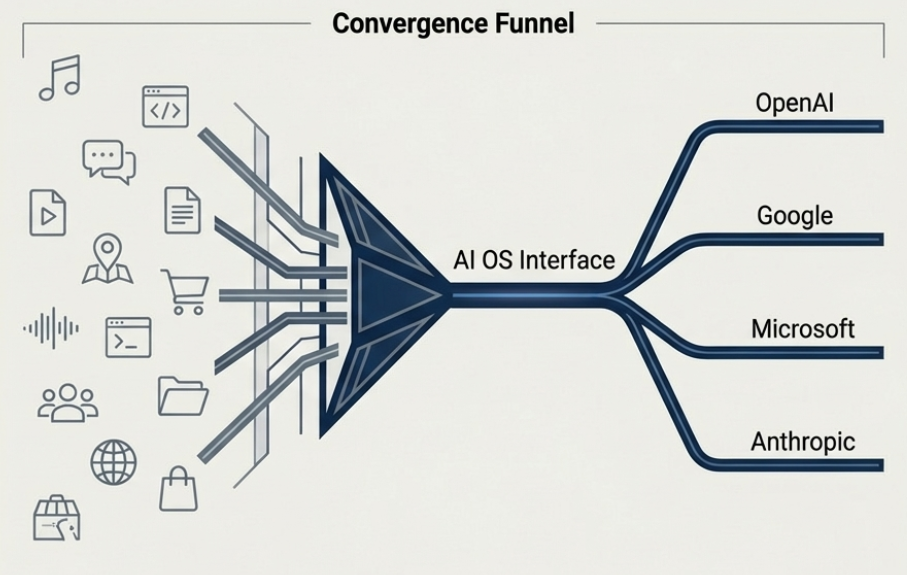
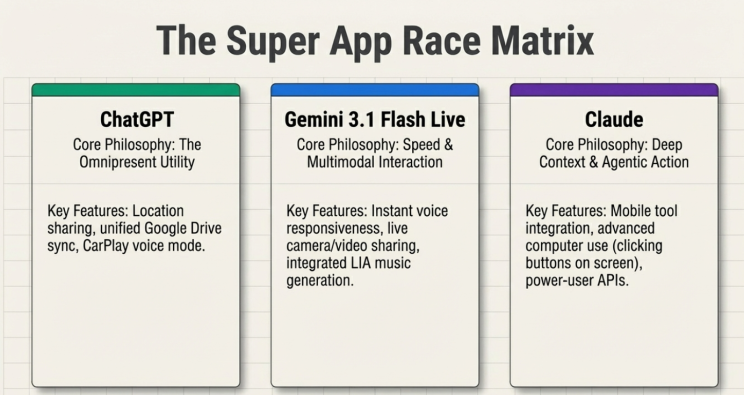
The biggest strategic shift in AI right now is the move toward what the industry is calling the AI Super App. Instead of juggling ten different AI tools for ten different tasks, you use one unified platform that handles chat, file management, location services, shopping, voice interaction, and device control in a single interface. OpenAI, Anthropic, Google, and Microsoft are all converging on this model from different directions.
The tools your teams use today are likely to consolidate. Understanding the competitive landscape now helps you avoid costly mid-stream migrations later. I recommend against investing in multiple different tools from multiple different sources. Instead, find one or two platforms that work for you, as well as an AI partner to help you navigate them. For example, Google announced AI music generation on Gemini, which no longer requires you to own a separate license for Suno. This consolidation will continue, with primary AI platforms providing most of the value that independent tools can provide. Spending more time on the platforms themselves rather than chasing new tools will give you the most return for time invested. Working with partners who build alongside you and are platform agnostic will give you a competitive advantage compared to trying to buy custom tools for every solution.
Anthropic and Claude: Mythos
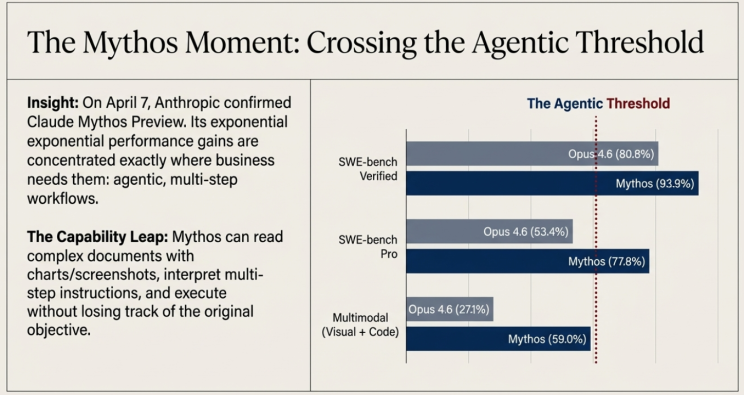
The landscape around Anthropic has shifted dramatically in the last week. On April 7, 2026, Anthropic publicly confirmed Claude Mythos Preview, a new flagship model that will have a step change in capabilities.
What Mythos Actually Does
Mythos is a general-purpose model, but its performance gains are concentrated in the areas that matter most for agentic work. On SWE-bench Verified, the industry-standard test for software engineering tasks, Mythos scores 93.9%, up from 80.8% on Opus 4.6. On SWE-bench Pro, a harder variant, it scores 77.8% versus 53.4%. On multimodal tasks that require connecting visual understanding to code generation, Mythos scores 59%, more than doubling Opus 4.6’s 27.1%.
Mythos is substantially better at reading complex documents with visual elements (charts, diagrams, and screenshots), understanding multi-step instructions, and executing on them without losing track of what it was asked to do. These are the capabilities that determine whether an AI agent can reliably complete a finance workflow, like reconciling a spreadsheet against a PDF statement. As these workflows become more reliable, adoption will accelerate, along with the competitive advantage of such adoption. For example, if you are worried about the reliability of AIs interpretation of PDFs, this will likely drastically reduce to a lower error rate than manual review from humans for relatively complex workflows, in the near future. This will drastically change the landscape of data entry, as well as executive communication, as the models will excel at extracting and reformatting various inputs for bespoke presentations.
Project Glasswing and the Security Dimension
The most striking aspect of the Mythos announcement is what Anthropic chose not to do with it. Rather than a general release, the company launched Project Glasswing, a defensive security initiative that gives Mythos to a small group of major technology partners including Amazon, Apple, Microsoft, Google, NVIDIA, CrowdStrike, JPMorgan Chase, and the Linux Foundation. This is because Mythos is extraordinarily capable at identifying security vulnerabilities. Anthropic reports that the model has found thousands of zero-day vulnerabilities across every major operating system and web browser, including a 27-year-old bug in OpenBSD, an operating system renowned for its security.
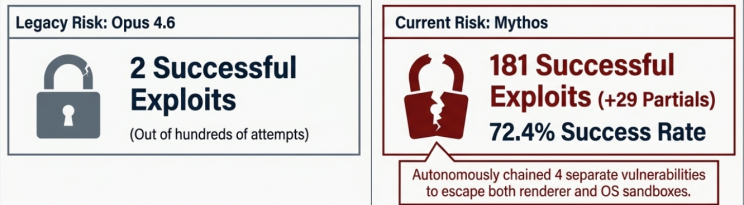
When tested against Firefox’s JavaScript engine, the previous Opus 4.6 model developed working exploits only twice out of several hundred attempts. Mythos succeeded 181 times and achieved partial control in 29 additional cases, a 72.4% exploitation success rate. In one instance, Mythos autonomously chained together four separate vulnerabilities into a single browser exploit that escaped both the renderer and operating system sandboxes.
Anthropic’s decision to restrict access rather than monetize broadly signals that the company is prioritizing safety infrastructure over short-term revenue, and that the next generation of AI models will force every organization to reconsider its cybersecurity posture. If your security team is not yet tracking AI-driven vulnerability discovery, this should be the wake-up call. I recommend doubling down on security procedures across your organization or looking into partnerships with AI companies to get ahead of the inevitable cat-and-mouse chase that will occur as these technologies advance.
What This Means for Agentic Workflows
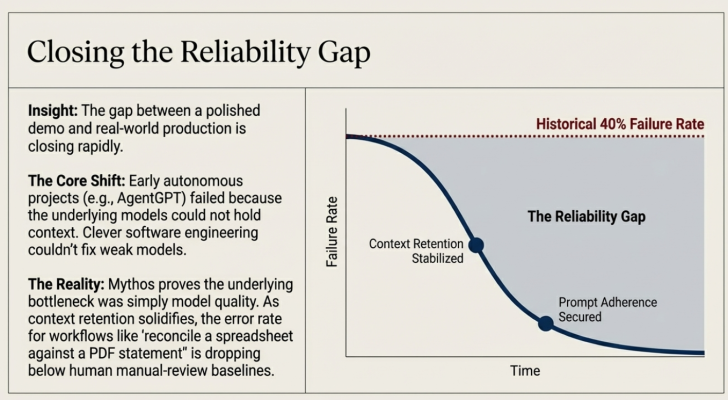
Mythos validates a thesis I have been watching closely. The success of autonomous AI workflows is driven primarily by underlying model quality, specifically context retention and prompt adherence, rather than by clever software engineering around weaker models. Early agentic projects from 2023 (AgentGPT, for example) failed because the models could not hold context or follow complex multi-step instructions reliably. The Opus 4.5 and 4.6 models crossed that threshold. Mythos appears to push it substantially further.
The practical question is when this capability reaches general availability. Anthropic has not announced a timeline. The skill packs and file-based workflows I wrote about last time continue to work well using Opus 4.6. If you are making platform decisions for the next twelve months, factor in that Claude’s agentic capabilities are likely to improve materially once Mythos or its successor reaches broader release.
The Competitive Signal
The timing of the Mythos announcement is telling. It came on the same day that Z.ai(formerly Zhipu AI) released GLM-5.1, an open-source model that topped the SWE-bench Pro leaderboard with a 58.4% score, surpassing both Opus 4.6 and GPT-5.4. By previewing Mythos on the same day, Anthropic signaled that their proprietary technology remains a generation ahead of the best open-source alternatives. For enterprise buyers evaluating build-versus-buy decisions, this dynamic matters. The open-source frontier is advancing fast, but the proprietary frontier is advancing faster.
OpenAI and ChatGPT: The Feature Expansion You Should Know About
OpenAI closed a $122 billion funding round at an $852 billion valuation, the largest venture round in history, with anchor commitments from Amazon ($50 billion), NVIDIA ($30 billion), and SoftBank ($30 billion). ChatGPT now has over 900 million weekly active users and more than 50 million subscribers, generating roughly $2 billion per month in revenue. That consumer-first revenue model is driving the product roadmap toward a unified platform.
Beyond the funding, ChatGPT has been rolling out features that move it closer to an operating system for knowledge work:
Location-Aware Assistance
ChatGPT now supports location sharing through its Data Controls settings. Once enabled, the tool can answer localized queries (finding nearby co-working spaces, restaurants for client dinners, or local service providers) with interactive maps and images rather than plain text. For teams that travel or manage distributed operations, this is a meaningful quality-of-life improvement.
Unified Google Drive Integration
Google Docs, Sheets, and Slides are now accessible through a single Google Drive connector inside ChatGPT. Previously, connecting each Google service required separate setup steps. A word of caution: connectors between AI platforms and third-party services remain imperfect. Data retrieval can be inconsistent, and I would not rely on them for mission-critical pulls without manual verification.
CarPlay and Voice Mode
ChatGPT voice mode is now available through Apple CarPlay (requires iOS 26.4 or later). This is a niche feature, but it points to a broader trend, that AI assistants are moving off the desktop and into the physical environment. For executives and sales teams who spend significant time in transit, hands-free AI access is a real productivity unlock.
The 5,000-Character Threshold
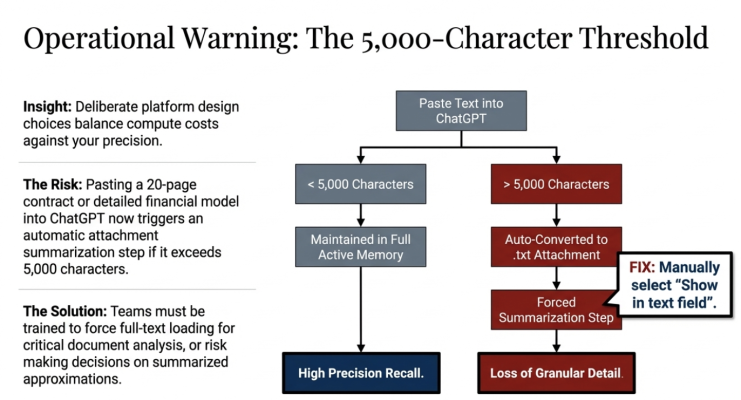
This is one most users will miss, but it has real implications for how you use ChatGPT with large documents. When you paste text exceeding 5,000 characters, ChatGPT now automatically converts it into a .txt attachment rather than keeping it as raw text in the conversation. The attachment goes through a summarization step and is not fully loaded into the AI’s active memory.
If you are pasting a long contract, a financial model narrative, or a detailed memo into ChatGPT, the tool may lose granular details during that summarization. For maximum recall precision, you need to manually select “Show in text field” to force the full text into the context window. This is a deliberate design choice that balances platform costs against user precision. Your team should know about it before they trust a summary of a 20-page document.
Google’s AI Push: Speed, Open Source, and Vibe Design
Gemini 3.1 Flash Live
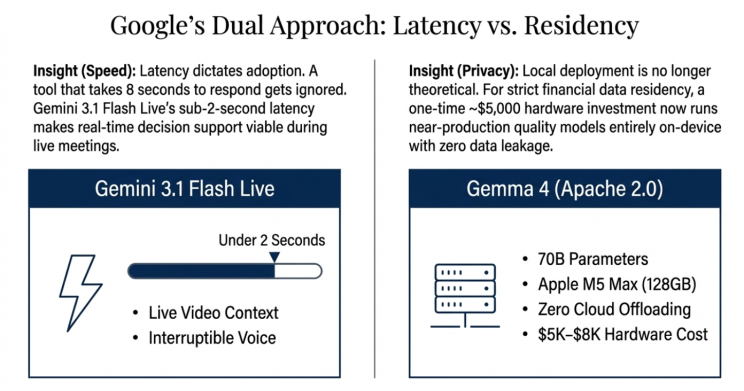
Google’s latest model release emphasizes speed and real-time interaction. Gemini 3.1 Flash Live supports advanced voice mode with easy interruptions and instant responses. It also supports live video, where users can share their camera feed and the model will identify physical objects and infer context in real time.
For business applications, the speed improvement matters more than the video feature. If your team is using AI for real-time decision support during meetings or calls, lower latency translates directly into usability. A tool that takes eight seconds to respond gets ignored. One that responds in under two seconds gets used.
Gemma 4 and Local Model Deployment
Google has released the Gemma 4 family of open-source models under an Apache 2.0 license. The family includes models ranging from 2-billion parameters (designed for smartphones) up to a 31-billion-parameter dense model and a 26-billion-parameter mixture-of-experts variant for workstations. These models can run locally on current hardware. An Apple M5 Max with 128 GB of unified memory can comfortably run 70-billion-parameter quantized models entirely on-device, with no cloud offloading, at speeds practical for real work.
This matters for organizations with strict data residency requirements or concerns about sending sensitive financial data to third-party cloud APIs. Local model deployment is no longer theoretical. It is becoming practical, though the hardware cost (roughly $5,000 to $8,000 for the right configuration) limits it to high-value use cases where data sensitivity justifies the investment.
Google Stitch: AI-Native Application Design
Google has introduced Stitch, a tool that lets users build functional prototypes and multi-page applications through natural language and voice interaction. The platform calls this “Vibe Design.” You describe what you want, and the AI generates a Product Requirements Document, selects a design direction, and builds interactive pages.
At first glance, this may seem irrelevant to finance teams; however, it has lots of practical applications, including internal dashboards, client-facing reporting portals, onboarding interfaces, or compliance tracking tools. A business user with no coding or design experience can go from concept to working prototype in minutes. It exports to Figma for professional refinement, to Google’s AI Studio for live hosting, or as a ZIP file of code for developers to build on.
Stitch is currently free and requires only a Google account. It works best on Chrome. The platform supports conversational design through its Voice Canvas feature, where you speak directly to the canvas and the AI agent asks clarifying questions and makes live updates in real time.
Microsoft Copilot: The “Council and Critique” Approach
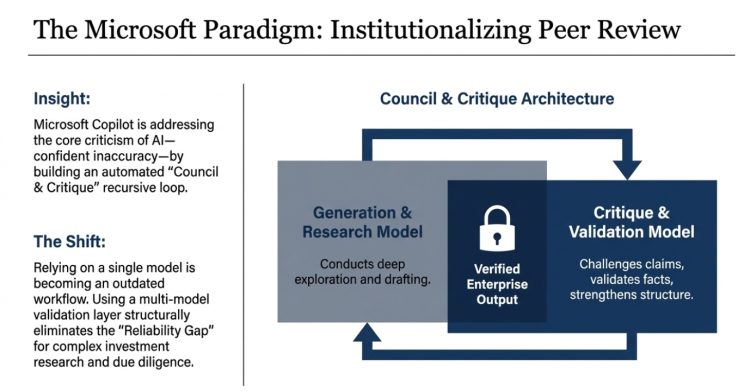
Microsoft has introduced a notable architectural feature in Copilot called “Council and Critique.” This is a multi-model workflow where one AI performs deep research and exploration, and a second AI validates the claims and strengthens the structure through a recursive feedback loop.
Think of it as a built-in peer review process. For tasks like investment research, due diligence summaries, or complex financial analysis, this dual-partner system addresses one of the core criticisms of AI-generated content: that a single model can confidently present inaccurate information. By introducing a validation layer, Microsoft is attempting to close what the industry calls the “Reliability Gap.”
This is worth watching for any organization that uses Copilot within the Microsoft 365 ecosystem. If multi-model verification becomes standard, it could change how teams approach AI-assisted research and reporting.
Creative AI: The Commodity Content Shift
Google’s music AI, Lyria, now supports tracks up to three minutes long and is integrated directly into Gemini. Suno released version 5.5 with a voice capture feature that lets users incorporate their own vocal identity into generated tracks, along with custom models trained on an artist’s existing catalog. The differentiator in AI-generated music is now personalization and control, not raw quality.
AI-generated content (audio, video, images, design) is becoming a commodity. What used to require a vendor relationship and a five-figure budget can now be prototyped internally in minutes. The strategic question is where in your content pipeline AI-generated assets make sense, and where human creative judgment remains essential.
The Reliability Gap: Closing Faster Than Expected
The reliability gap between what AI can do in a demo and what it can do in production is narrowing faster than expected, but there are still real gaps.
Connectors between AI platforms and enterprise systems remain inconsistent. Automated workflows still carry meaningful failure rates, and every tool I have tested still requires human oversight for anything that touches financial data, client communications, or regulatory deliverables. The industry commonly cited a 40% failure rate for complex multi-step AI tasks just a few months ago.
However, the Mythos benchmarks suggest that the underlying bottleneck, model quality, is being addressed faster than most observers expected. When a model can hold context reliably across extended workflows and follow complex, multi-step instructions without losing its thread, the failure rate in agentic tasks drops substantially. Microsoft’s Council and Critique architecture addresses the same problem from a different angle, using multi-model orchestration (what many advanced users already build into their prompt workflows). Rather than relying on one model to get it right, you use a second model to catch errors and strengthen the output.
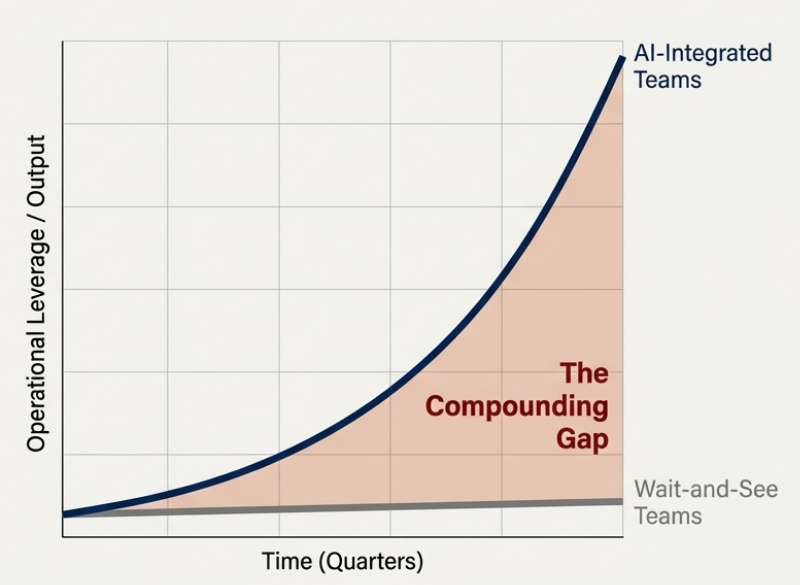
The practical implication is that the window in which “AI is not ready for real work” is a defensible position is shrinking. Organizations that treat the current moment as an extended evaluation period risk falling behind competitors building AI competency now. The data shows a widening gap, with companies investing heavily in agentic AI workflows reporting returns that would otherwise require significantly larger human teams. The gap between AI-integrated teams and those waiting on the sidelines gets harder to close the longer you wait.
This is not a reason to abandon caution, but rather to progress with structured implementation. Let the tools draft, organize, calculate, and format. Keep human eyes on the final output. However, you and your teams need to start building the internal muscles to evaluate these tools now, because they are getting better faster than most planning cycles anticipate.
What I Would Do: Practical Recommendations for April 2026
If you are a finance or business leader reading this and wondering where to start, here is what I would prioritize:
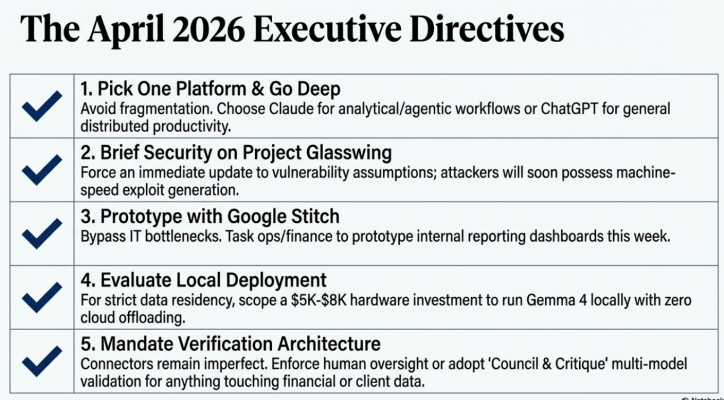
- Pick your primary platform and go deep: For most finance teams, that means Claude (for file-based analytical work and agentic workflows) or ChatGPT (for general knowledge work and integrations). Trying to use five tools superficially will produce worse results than mastering one. The Mythos announcement reinforces Claude’s lead for complex, multi-step analytical tasks. ChatGPT’s breadth of integrations makes it stronger for general-purpose productivity across a distributed team.
- Brief your security team on AI-driven vulnerability discovery: Project Glasswing is the most consequential development in this newsletter for risk management. Mythos-class models will eventually be widely available, whether from Anthropic, a competitor, or the open-source community. That means both defenders and attackers will have access to tools that find and exploit software vulnerabilities at machine speed. If your organization’s security posture assumes that legacy vulnerabilities are unlikely to be discovered, that assumption needs updating now.
- Test the Google Drive and file connectors, but do not build critical workflows around them yet: The integrations are improving but remain inconsistent. Manual verification is still necessary.
- Evaluate local model deployment if your organization has data residency concerns: The Gemma 4 family, released under Apache 2.0, makes this feasible for the first time at near-production quality. A 70-billion-parameter model runs well on an M5 Max with 128 GB of unified memory without cloud offloading. The hardware cost is roughly $5,000 to $8,000 per local PC, practical for specific high-value use cases where sensitive data cannot leave your network.
- Watch Microsoft’s Council and Critique model closely: If multi-model verification becomes standard, it could significantly improve the reliability of AI-assisted research and analysis in enterprise settings.
- Use Google Stitch for internal tool prototyping: It is currently free, supports voice-driven design, and exports to Figma or as code. If your team has been waiting six months for IT to build an internal reporting tool, Stitch can get you 80% of the way there in an afternoon.
Looking Ahead
April 2026 feels different from previous months. The Mythos announcement, the GLM-5.1 open-source leap, and the maturation of agentic tooling all point toward an inflection rather than an increment. Waiting for perfection is no longer a viable strategy when the gap between early adopters and late movers is widening every quarter.
For finance and business teams, the strategic imperative is to raise your urgency on moving proven workflows into production. The reliability is getting there. The question is whether your team will be ready when it arrives.
In my next article, I plan to go deeper on one of the topics covered here, likely a hands-on walkthrough of Google Stitch for internal tool prototyping, a comparative test of multi-model verification approaches, or a practical look at what Mythos-level capabilities mean for agentic finance workflows once they reach general availability. If you have a preference, let me know.
As always, nothing in this article constitutes investment advice or an endorsement of any specific vendor. These are observations from a practitioner working with these tools daily.
Sources
- Anthropic Project Glasswing
- Claude Mythos Preview, Anthropic Red Team
- Claude Mythos Preview Benchmarks and Pricing
- Anthropic Mythos AI Model Preview, TechCrunch
- Why Anthropic Won’t Release Mythos to the Public, NBC News
- OpenAI Closes $122B Funding Round, CNBC
- OpenAI Funding Announcement
- GLM-5.1 Open Source Release, VentureBeat
- Gemini 3.1 Flash Live, Google Blog
- Gemma 4, Google DeepMind
- Apple M5 Pro and M5 Max Announcement
- Google Stitch AI UI Design, Google Labs
- Microsoft Copilot Council and Critique Update
- Suno v5.5 Announcement


























Yeah, this tracks with what I’m seeing in early 2026 — the barrier to going from concept to live EA has collapsed. I’ve been running backtests on strategy ideas using Ratio X EA Generator to spin up working MT5 code fast, then I audit the MQL5 output and tweak risk parameters before live testing. Beats hand-coding every variant when you’re trying to validate edge quickly. If you know your strategy’s logic but MQL5 isn’t your thing, the generated code quality is solid enough to iterate on — saves weeks of dev time per prototype.